Kamis, 02 Mei 2013
Several of My Works Cited in a Recent Fifth Circuit Decision
Unfortunately, in the dissent from the en banc decision to not rehear NRA et al. v. BATF (5th Cir. 2013) concerning the legal minimum age for sales of handguns to 18-20 year olds. There are actually at least four citations to my work there.

An Interesting Person Passed During The Night
My stepmother-in-law, Bette Thorne, died of pneumonia in a hospital in British Columbia. She has been declining for a number of years now from Alzheimer's, and it is hard to see this as a great tragedy. Still, she had some interesting stories to tell when she was doing better. Shortly before my father-in-law died of cancer, my wife and I drove Better and him up from Orange County, and I spent a bit of time talking to her about her life, and there was much of interest to learn from her.
She grew up in a rough section of Chicago where the Catholic kids regularly called her a "Christ-killer" because she was Jewish. (This was the 1930s.) She served with the U.S. Army Air Force during World War II, and one of her duty assignments was in New Guinea, deep in a jungle airbase. She met her husband, who was also with the AAF, and after the war, they raised their twin sons in Manila, living what was apparently a very charmed, almost colonial life.
Talk to everyone that you have a chance to meet: they all have some interesting stories to tell.
She grew up in a rough section of Chicago where the Catholic kids regularly called her a "Christ-killer" because she was Jewish. (This was the 1930s.) She served with the U.S. Army Air Force during World War II, and one of her duty assignments was in New Guinea, deep in a jungle airbase. She met her husband, who was also with the AAF, and after the war, they raised their twin sons in Manila, living what was apparently a very charmed, almost colonial life.
Talk to everyone that you have a chance to meet: they all have some interesting stories to tell.
Rabu, 01 Mei 2013
Another Brilliant Idea From My Readers
Glen's comments below were pretty useful: he pointed out that had I mounted the truss block where the mirror is, it would have reduced the bending moment. I can't mount that where the mirror cell (too many things in the way) but I can mount the truss blocks below the mirror cell (although of course, with longer tubes). I have an intuitive sense that this would pretty well eliminate the bending of the tube, since the center of gravity would now be above where the truss blocks are. Does this make sense to everyone?
I am assuming that I can find 1", .050" wall aluminum tubing from my local vendor. They won't be black, but I can flat black paint them easily enough, and there won't be any shipping charges. Better, I can have them cut me the lengths that I want, and I won't be paying for the excess that I don't need. It increases the weight by a few ounces per tube, but that probably is not much worse than the weight of adding a coat of fiberglass to the lower tube.
So, what's everyone's opinion? Will putting the truss blocks below the weight of the mirror on the lower cage substantially reduce this problem?
UPDATE: Another possibility is to have another ring like the last one rolled by the elves (I mean, Chicago Metal Rolled Products), but with a 1/4" wall instead of a 1/8" wall like the current one. That would add almost six pounds to it, unfortunately, but it would be, I think, quite sufficiently stiff. I have requested a quote from them. Perhaps I would put more effort into cutting down the walls of the C-channel to take a couple of pounds off there -- what is in place currently has no measurable deflection.
UPDATE 2: It just occurred to me that there is another approach that doesn't involve spending a penny. The 1" square tube that used to be used for connecting the upper and lower cages is still sitting around. I could use these on the exterior of the lower cage (where there are still attachment holes) to increase stiffness of the tube in the very area where the bending is taking place. Perhaps put a thin piece of aluminum plate (which I have lying around) on the inside of the tube to increase stiffness.
I am assuming that I can find 1", .050" wall aluminum tubing from my local vendor. They won't be black, but I can flat black paint them easily enough, and there won't be any shipping charges. Better, I can have them cut me the lengths that I want, and I won't be paying for the excess that I don't need. It increases the weight by a few ounces per tube, but that probably is not much worse than the weight of adding a coat of fiberglass to the lower tube.
So, what's everyone's opinion? Will putting the truss blocks below the weight of the mirror on the lower cage substantially reduce this problem?
UPDATE: Another possibility is to have another ring like the last one rolled by the elves (I mean, Chicago Metal Rolled Products), but with a 1/4" wall instead of a 1/8" wall like the current one. That would add almost six pounds to it, unfortunately, but it would be, I think, quite sufficiently stiff. I have requested a quote from them. Perhaps I would put more effort into cutting down the walls of the C-channel to take a couple of pounds off there -- what is in place currently has no measurable deflection.
UPDATE 2: It just occurred to me that there is another approach that doesn't involve spending a penny. The 1" square tube that used to be used for connecting the upper and lower cages is still sitting around. I could use these on the exterior of the lower cage (where there are still attachment holes) to increase stiffness of the tube in the very area where the bending is taking place. Perhaps put a thin piece of aluminum plate (which I have lying around) on the inside of the tube to increase stiffness.
Senin, 29 April 2013
A Warped Idea
One of the issues with trying to roll my own fiberglass rube to replace the metal in the lower cage to get improved stiffness without a lot more weight is the need to get 20" diameter molds. Car wheels would be expensive, but assuming that I did not get anything on them (since you wrap a plastic sheet around them before you start glopping on the epoxy), they would be resellable afterwards. And there are plenty of used, cosmetically challenged but still round 20" wheels out there, I think.
What happens if you take an existing aluminum tube, and add a layer of fiberglass and resin? The resin alone would dramatically stiffen it, and the fiberglass would make it strong as well. Or will thermal expansion coefficient differences between the aluminum and fiberglass cause it to crack the fiberglass layer?
What is attractive about this warped idea:
1. No need for 20" molds.
2. It covers over all the existing holes, although the one that are still needed could be recreated by drilling from the inside, or by putting something in them to prevent them from being covered over by the fiberglass.
3. Minimal materials costs, since I don't need to make an entire 20" ID fiberglass tube -- just improve an existing piece of aluminum with what would likely be one layer of fiberglass cloth and resin. The result would be far stiffer than the current aluminum, and would not add enormous weight.
If this seems strange, there is a long practice in amateur telescope making of epoxying cardboard concrete forms tubing to get the cheapness of Sonotube with the improved moisture resistance and improved looks of fiberglass. Any thoughts?
If you are wondering about lack of interest in politics and current affairs at the moment: I can only focus like a laser beam on one intense project at a time. And the overwhelming lack of interest by magazines on this topic that should be interested in my research on the ineffectiveness of background checks for reducing murder rates has left me feeling like the effort in that area is a bit wasted.
UPDATE: I meant to look this up this morning, but a reader's comment pushed me to do so. Aluminum has a thermal coefficient of expansion of 22.2 x 10⁻⁶ m/m/K; unfilled epoxy is 55, or more than twice as much expansion. If I understand the units correctly, this means that a meter of aluminum will expand .00000222 meters for every degree Kelvin (or Celsius) of temperature increase. The normal range of temperatures that this part will be exposed to is about 70 degrees Fahrenheit, or about 40 degrees Celsius; a part that is .0023 meters thick will therefore expand by billionths of a meter, or 0.0000080409288 inches. Even with repeated cycles -- I am having a hard time imagining this alone would play any significant role in delamination. There are doubtless other problems behind the delamination problem that commenter below describes.
I am going to experiment with some Coke cans this evening to see how what a layer of fiberglass does to the stiffness of what is universally recognized as a very flexible piece of aluminum. This is also a remarkably smooth aluminum surface, much less likely to accept epoxy than the tube that I would need to actually turn into an aluminum fiberglass composite. If it doesn't just turn into a mold for the tube, the combination will give me confidence that my strategy can work.
What happens if you take an existing aluminum tube, and add a layer of fiberglass and resin? The resin alone would dramatically stiffen it, and the fiberglass would make it strong as well. Or will thermal expansion coefficient differences between the aluminum and fiberglass cause it to crack the fiberglass layer?
What is attractive about this warped idea:
1. No need for 20" molds.
2. It covers over all the existing holes, although the one that are still needed could be recreated by drilling from the inside, or by putting something in them to prevent them from being covered over by the fiberglass.
3. Minimal materials costs, since I don't need to make an entire 20" ID fiberglass tube -- just improve an existing piece of aluminum with what would likely be one layer of fiberglass cloth and resin. The result would be far stiffer than the current aluminum, and would not add enormous weight.
If this seems strange, there is a long practice in amateur telescope making of epoxying cardboard concrete forms tubing to get the cheapness of Sonotube with the improved moisture resistance and improved looks of fiberglass. Any thoughts?
If you are wondering about lack of interest in politics and current affairs at the moment: I can only focus like a laser beam on one intense project at a time. And the overwhelming lack of interest by magazines on this topic that should be interested in my research on the ineffectiveness of background checks for reducing murder rates has left me feeling like the effort in that area is a bit wasted.
UPDATE: I meant to look this up this morning, but a reader's comment pushed me to do so. Aluminum has a thermal coefficient of expansion of 22.2 x 10⁻⁶ m/m/K; unfilled epoxy is 55, or more than twice as much expansion. If I understand the units correctly, this means that a meter of aluminum will expand .00000222 meters for every degree Kelvin (or Celsius) of temperature increase. The normal range of temperatures that this part will be exposed to is about 70 degrees Fahrenheit, or about 40 degrees Celsius; a part that is .0023 meters thick will therefore expand by billionths of a meter, or 0.0000080409288 inches. Even with repeated cycles -- I am having a hard time imagining this alone would play any significant role in delamination. There are doubtless other problems behind the delamination problem that commenter below describes.
I am going to experiment with some Coke cans this evening to see how what a layer of fiberglass does to the stiffness of what is universally recognized as a very flexible piece of aluminum. This is also a remarkably smooth aluminum surface, much less likely to accept epoxy than the tube that I would need to actually turn into an aluminum fiberglass composite. If it doesn't just turn into a mold for the tube, the combination will give me confidence that my strategy can work.
Minggu, 28 April 2013
Done With Big Bertha
Maybe in more ways than one. I ended up using the steel rods epoxied to the tube to create a flat base for the Moonlite truss connector blocks -- and this worked out well. Minimal material, minimal weight, and once the screws were tightened down, there is no risk of those rods working loose.
After wrestling with getting the truss tubes in place (rather like wrestling a very large insect, I suspect, without the horror film aspects), this is what we have:

My objectives for the rebuild were:
1. Reduce weight.
2. Improve stiffness of the structure.
3. Make it a bit easier to transport.
To my shock, #1 was a complete failure. It was 61 pounds before, and it is 61 pounds after--in spite of cutting away more than half of the aluminum C-channel that was the base.
The truss tube structure is, I think, considerably stiffer than what I had before. But it appears that now the flex isn't in the structure between the upper and lower cages, but between the lower cage and the saddle. Remember that I no longer have a 72" C-channel between the two cages. The flex is increased because of that, to no great surprise. In addition, to save a pound, I replaced the 19" Losmandy dovetail plate with a 13.5" plate. This means that there is less stiffness between the lower cage and the saddle. Overall, I think I have turned a barely tolerable amount of flex which varied by angle into an intolerable amount of flex in wind of any sort -- although I won't know for sure until I roll it out under a dark sky. But I managed to spend more than $300 and much of two days doing so.
The only way to salvage this disaster might be to replace the existing aluminum C-channel with carbon fiber composite C-channel like this. But that will be almost $200 with shipping, and before I do that, I want some serious confidence that it is going to have deflection measured in thousandths of an inch from a 55 pound load.
The temptation is very strong to just give up on trying to have a serious 17.5" reflector on an equatorial mount. The choices seem to be:
1. A solid tube, which makes it heavy enough that I need a $6000 mount for it.
2. Dobsonian mount, which greatly complicates astrophotography. (There are ways, but they don't impress me.)
UPDATE: A little playing with it leads me to believe that I moved the flexibility from the structure to the lower cage. The half-Suerrier truss appears to be completely rigid, nor does it appear where the lower cage meets the saddle of the mount is flexing. It looks like the lower cage is flexing! I'll take some video of it, and then play it back frame by frame tomorrow night. If so, I might just need to have a thicker aluminum tube made -- perhaps .125" or .1875" wall instead of the current .090" wall. Or perhaps even make a fiberglass tube. (Carbon fiber composite? Like $1600.) I have made small fiberglass tubes before; I would certainly make a 4" ID then an 8" ID tube first as a experiment. The big problem is appropriate molds. I had thought of using 20" pizza pans for this, but what about 20" car wheels? They have the advantage of being very wide, and perhaps I could borrow a couple from someone for this purpose.
Here's the video. I haven't gone through it frame by frame, but it looks to me like the tube is flexing.
UPDATE 2: Definitely: the lower tube is flexing, not the truss tube structure or the support.
After wrestling with getting the truss tubes in place (rather like wrestling a very large insect, I suspect, without the horror film aspects), this is what we have:
My objectives for the rebuild were:
1. Reduce weight.
2. Improve stiffness of the structure.
3. Make it a bit easier to transport.
To my shock, #1 was a complete failure. It was 61 pounds before, and it is 61 pounds after--in spite of cutting away more than half of the aluminum C-channel that was the base.
The truss tube structure is, I think, considerably stiffer than what I had before. But it appears that now the flex isn't in the structure between the upper and lower cages, but between the lower cage and the saddle. Remember that I no longer have a 72" C-channel between the two cages. The flex is increased because of that, to no great surprise. In addition, to save a pound, I replaced the 19" Losmandy dovetail plate with a 13.5" plate. This means that there is less stiffness between the lower cage and the saddle. Overall, I think I have turned a barely tolerable amount of flex which varied by angle into an intolerable amount of flex in wind of any sort -- although I won't know for sure until I roll it out under a dark sky. But I managed to spend more than $300 and much of two days doing so.
The only way to salvage this disaster might be to replace the existing aluminum C-channel with carbon fiber composite C-channel like this. But that will be almost $200 with shipping, and before I do that, I want some serious confidence that it is going to have deflection measured in thousandths of an inch from a 55 pound load.
The temptation is very strong to just give up on trying to have a serious 17.5" reflector on an equatorial mount. The choices seem to be:
1. A solid tube, which makes it heavy enough that I need a $6000 mount for it.
2. Dobsonian mount, which greatly complicates astrophotography. (There are ways, but they don't impress me.)
UPDATE: A little playing with it leads me to believe that I moved the flexibility from the structure to the lower cage. The half-Suerrier truss appears to be completely rigid, nor does it appear where the lower cage meets the saddle of the mount is flexing. It looks like the lower cage is flexing! I'll take some video of it, and then play it back frame by frame tomorrow night. If so, I might just need to have a thicker aluminum tube made -- perhaps .125" or .1875" wall instead of the current .090" wall. Or perhaps even make a fiberglass tube. (Carbon fiber composite? Like $1600.) I have made small fiberglass tubes before; I would certainly make a 4" ID then an 8" ID tube first as a experiment. The big problem is appropriate molds. I had thought of using 20" pizza pans for this, but what about 20" car wheels? They have the advantage of being very wide, and perhaps I could borrow a couple from someone for this purpose.
Here's the video. I haven't gone through it frame by frame, but it looks to me like the tube is flexing.
UPDATE 2: Definitely: the lower tube is flexing, not the truss tube structure or the support.
The Rebuild Has Begun
Remember the scene near the end of Animal House, where the rough, biker sort puts on his welding goggles, lights up the torch, and starts the transformation of the brother's Lincoln Continental into...something wondrous? That's about how it felt to start disassembling Big Bertha for her bariatric surgery.
Here's the Losmandy DUP dovetail plate -- where "U" stands for universal, and the collection of different locations sizes, and types of holes really shows you what is intended to handle -- including attaching your Klingon Death Ray projector:

Here's the other side, which is both relieved so that you can put various nuts on it, and I suspect to reduce weight.

Here are the anodized tubes for the trusses from Moonlite:

Here are the blocks that hold everything together:

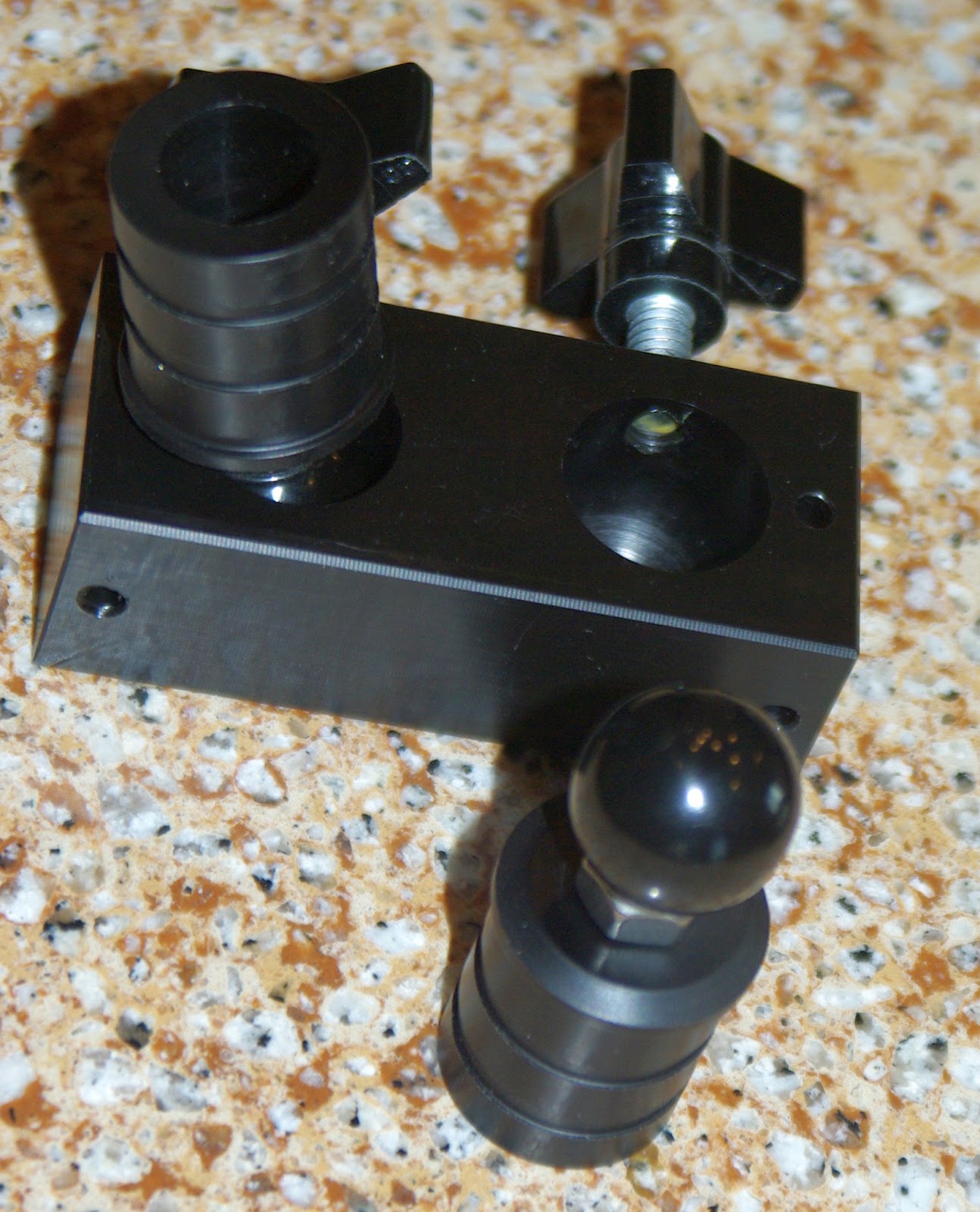
The balls go into the blocks, and you bolt the cylinder end into the poles, after you have cut them to the correct length for your particular telescope.
I was able to buy black oxide 6-32 screws to hold the blocks into the lower and upper cages, but I could not seem to find black oxide coated washers or nuts, so my wife did them in flat black spray paint:


Here's Big Bertha removed from her mount. She weighs just under 62 pounds.

Since I had to remove the turnbolts, guy wires, and the aluminum tubing and channels, my wife suggested that we repaint the exteriors of the lower and upper cages:

This was a surprisingly strenuous four hours of work. I also made a bunch of 1", 1/8" diameter steel pins that will be used to provide a flat base on the tube for the truss connector blocks.
Here's the Losmandy DUP dovetail plate -- where "U" stands for universal, and the collection of different locations sizes, and types of holes really shows you what is intended to handle -- including attaching your Klingon Death Ray projector:
Here's the other side, which is both relieved so that you can put various nuts on it, and I suspect to reduce weight.
Here are the anodized tubes for the trusses from Moonlite:
Here are the blocks that hold everything together:
The balls go into the blocks, and you bolt the cylinder end into the poles, after you have cut them to the correct length for your particular telescope.
I was able to buy black oxide 6-32 screws to hold the blocks into the lower and upper cages, but I could not seem to find black oxide coated washers or nuts, so my wife did them in flat black spray paint:
Here's Big Bertha removed from her mount. She weighs just under 62 pounds.
Since I had to remove the turnbolts, guy wires, and the aluminum tubing and channels, my wife suggested that we repaint the exteriors of the lower and upper cages:
This was a surprisingly strenuous four hours of work. I also made a bunch of 1", 1/8" diameter steel pins that will be used to provide a flat base on the tube for the truss connector blocks.
Langganan:
Postingan (Atom)